Journaling for Anxiety: Gentle Ways to Start
Journaling for anxiety can start with one worry, what you know, and one next step. Use gentle prompts, a stopping point, and guidance on when to seek help.
By Her's Notion Planner by Cosmo Suite · Editorial policy
Published · 8 min read
General information, not medical advice.
You write “Anxiety is here” on the page, then wait for a next sentence. The blank page can make a simple idea feel like homework, especially when every prompt list asks you to unpack the whole story.
Use a short entry with four parts: the worry, what you know, what you are guessing, and one next step or a note that nothing needs action right now. This reflection exercise organizes a page. It cannot diagnose or treat anxiety. Stop if writing feels unhelpful.
In a Nutshell:
- Choose one worry at a time.
- Write what you know separately from what you predict.
- End with a small action, support person, or a clear stopping point.
- Put the page away if writing increases your distress.
Journaling can organize a worry, but it is not treatment
An anxiety journal is a personal place to write down a worry, what you know about it, and an optional next step. It gives you room to describe a thought and decide what you want to do with the page. It cannot tell you whether a thought is true, diagnose a condition, or replace care from a licensed professional.
Online advice often presents journaling as a quick way to calm down. Research does not support that as a blanket promise. A 2025 meta-analysis by O’Meara and Lovett examined single-session expressive writing before tests. Across 21 studies and 1,457 participants, it found no significant effect on test anxiety (published online 19 September 2025). That result is about one kind of writing in a test setting. It does not answer every question about journaling, and it does not make journaling a treatment.
The NHS Every Mind Matters thought record uses a structured CBT exercise to note a situation, thoughts, feelings and evidence. This guide uses a simpler reflection prompt. Follow the NHS steps or your therapist’s guidance when you want a structured exercise.
Talk with a licensed health professional if anxiety keeps interrupting sleep, work, relationships or daily routines. The U.S. National Institute of Mental Health explains ways to find mental health care. If you may hurt yourself or someone else, contact your local emergency or crisis service now. In the United States, call or text 988 for the Suicide & Crisis Lifeline.
A gentle anxiety journal at a glance
A short entry can move from the worry to a useful ending without asking you to solve everything.
| If you need… | Try this | Stop when… |
|---|---|---|
| A place to begin | Write the worry as one plain sentence | You have named the thought |
| A reality check | Split facts from predictions | You have listed what you know |
| A next step | Choose one action or person who can help | The next action is clear |
| A pause | Close the page and look around the room | You feel ready to stop writing |
Use the table as a menu. Choose one row and leave the others for another day. If a prompt feels too personal, pick a simpler one or skip it.
Use one page to separate facts from predictions
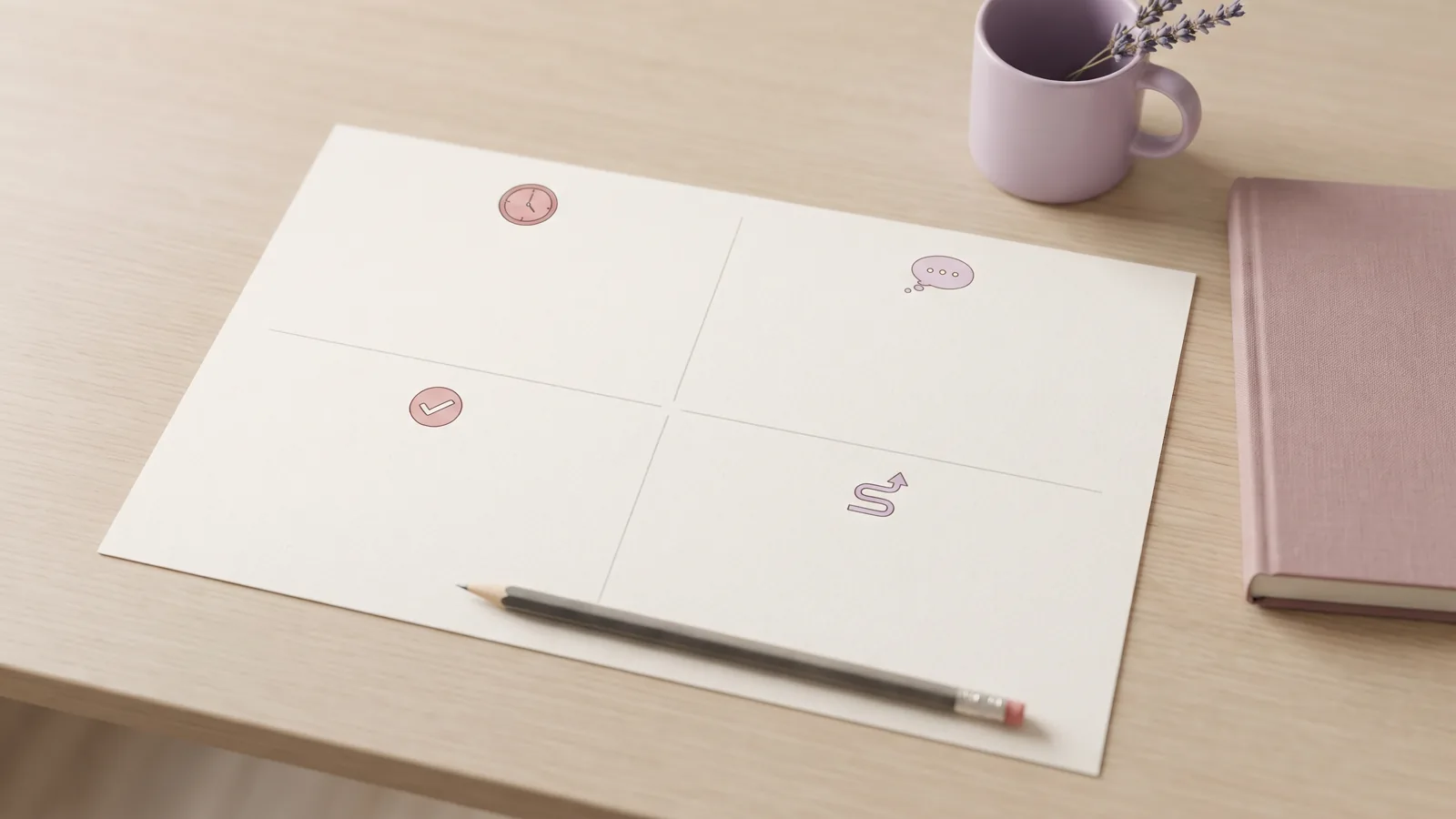
When a worry feels tangled, use four small spaces: the situation, the thought, what you know, and what you might do. This page helps organize a reflection. It is not a clinical worksheet.
Try this sequence:
- Name the moment. Write what happened in plain language. Keep it specific, such as “There is no reply about Friday’s plans yet.”
- Write the thought. Use the words that are already in your head. You do not need to make the thought sound reasonable.
- Mark what you know. List details you could confirm. Put guesses in a separate line.
- Choose an ending. Write one next step, someone you could ask for support, or “Nothing needs action tonight.”
For example, imagine you sent a message about weekend plans and have not received a reply. The thought might be, “They are upset.” The known details could be, “The message went out this morning. No reply has arrived yet.” A next step might be, “Check once tomorrow,” or “Ask directly when we talk.” This is a fictional example, not a test of whether the worry is correct.
The NHS thought record uses seven prompts to examine a situation, feelings and evidence. Use that resource if you are looking for the NHS exercise. If you are already working with a therapist, follow their guidance about whether and how to journal.
The facts line separates what you can check from what your mind is predicting. You can close the page without deciding whether the worry is true. Some entries will end with “The answer is not clear yet.” If more information would help, note when you might look for it. Otherwise, leave the question open.
Keep the example as small as the concern. For a conversation, write the part you can confirm and one way to follow up. For something outside your control, name that and decide what you want to do with the rest of the evening. A long list of possible outcomes can make the page harder to use.
Keep this four-part page on paper, in a private phone note, or in a planner you already open. If your everyday planning lives in Notion, Her's Notion Planner has a Wellness hub and dashboards for desktop, tablet and phone. The template does not provide mental-health care. You can use this exercise without buying anything.
Pick a prompt that feels manageable today
Choose one prompt based on what you can write right now. You do not have to answer the whole list.
When you only have a few words:
- What is taking up the most space right now?
- Which details are confirmed?
- What can wait until later?
When you want to make a plan:
- What is one small next step?
- Who could help with this?
- When would it help to check again?
When the worry is hard to describe:
- What was happening when this thought showed up?
- What words describe this feeling?
- Would writing, a voice note, or a pause suit me right now?
These prompts are deliberately plain. You are not trying to force a positive answer or prove that a fear is impossible. A journal entry can hold uncertainty. “The answer is unclear” is a complete answer.
Pick the question that asks the least of you. If you can only write a few words, stop there. If a prompt brings up a detail you would rather leave alone, skip it. You can write about the practical part of a concern without describing every feeling or event around it. A journal belongs to you; there is no required level of detail.
The Oxford Health NHS Foundation Trust anxiety guide includes writing and problem-solving activities. It suggests defining a problem clearly before listing possible solutions. That can be useful when a worry includes a practical task. Use the guide as general self-help information, and ask a health professional for advice about your situation.
To keep a prompt nearby, write one short line on a card or in a place you use. A short night routine for tomorrow planning is another example of keeping a written note focused on one task. It covers everyday planning, not anxiety treatment.
Give your entry a stopping point
An entry can end while the worry remains unresolved. Choose a comfortable limit, then close the notebook or note.
A few ways to stop:
- Use one prompt, then pause.
- Write one line about what you know and one line about what comes next.
- Leave a blank page if words are not coming.
- Choose an ordinary activity that helps you shift attention, such as making tea or texting someone you trust.
- Return another time only if you want to.
If writing brings up more distress, stop. Leave the page unfinished. Try a different activity, move to a shared space, or contact someone you trust. When distress is hard to manage, a licensed professional can help you decide what support fits. The NIMH help page includes routes to care in the United States; readers elsewhere can use their local health service.
Check privacy before choosing a format. A journal may hold details you would not want to share. Consider where a notebook stays, whether a phone note syncs to other devices, and who can access a shared account. You can write less, use initials, or leave the entry unsaved.
Choose a time that feels manageable. A worry may feel too close in the middle of a difficult moment. Make a brief note to return later, or leave the page closed. Use a journal when the format feels useful. You do not need a daily streak or a review of old entries.
A tiny repeatable routine can be easier to return to than a long daily assignment. Some people prefer a paper notebook. Others use a phone note or a planner. You do not need a streak, a score or a perfect page. If you want a wider view of everyday plans, see how Her's Notion Planner organizes its five hubs. The four-part note also works on paper or in a phone note.

When a planner can hold the routine
A planner can keep an everyday reflection near other plans. Use it as a place to write, with health care questions directed to a licensed professional.
Her's Notion Planner is a Notion template with five hubs, including Wellness, and dashboards for desktop, tablet and phone. If you already use Notion for personal planning, you can look at the planner's connected hubs and setup guide to see whether its layout suits you. It is a planning product, not a mental-health service. A plain notebook or free note app works just as well for this exercise. For a broader check on Notion layouts, the guide to choosing an aesthetic Notion template that stays usable covers the visual side of everyday planning.
Keep the page simple: date, one worry, what you know, and what you want to do next. Skip ratings or tracking if they draw more attention to the feeling than you want. The Notion habit tracker guide shows a different kind of weekly check-in for everyday habits. You do not need to track anxiety to use a journal.
Why trust this article
Her's Notion Planner by Cosmo Suite prepared this guide from dated public health resources and a peer-reviewed meta-analysis. The cited study tested single-session expressive writing for test anxiety, so the article limits its summary to that setting. The journal prompts here are an original reflection format. They are not a clinical tool. The site's editorial policy explains how Cosmo Suite makes and checks its content.
Frequently asked questions
What should I write in a journal when I feel anxious?
Write one worry in your own words. Note what you know, what you are predicting, then add one small next step or source of support. A few lines are enough.
How long should I journal for anxiety?
There is no fixed length. Try one prompt and a short timer if that feels manageable. Stop when the timer ends, or sooner if writing feels worse.
Can journaling treat anxiety?
A journal gives you a place to record thoughts. It is not a diagnosis or treatment plan. Talk with a licensed health professional if anxiety affects daily life.
Should I journal every day?
No. Write when a particular thought feels useful to record, or choose a light check-in that fits your routine.
What if journaling makes me feel more anxious?
Close the journal and choose something steady, such as naming what you can see or contacting someone you trust. If distress continues, reach out to a licensed professional.
Can I journal on my phone?
Yes. A notebook, private note or voice memo can hold a short reflection. Choose a format that feels comfortable and check who can access it.
